kimono
A type of traditional Japanese clothing, consisting of a long, wide-sleeved robe, closed at the front forming a "y" shape. It is held closed with a wide belt-like sash called an obi. The sleeves can be tied back with tasuki.
Kimonos are often worn with other traditional accessories, such as zouri (traditional wooden sandals), tabi (split-toe socks), and kanzashi (traditional hair ornaments). A kinchaku (small cloth drawstring bag) is often carried while wearing a kimono.
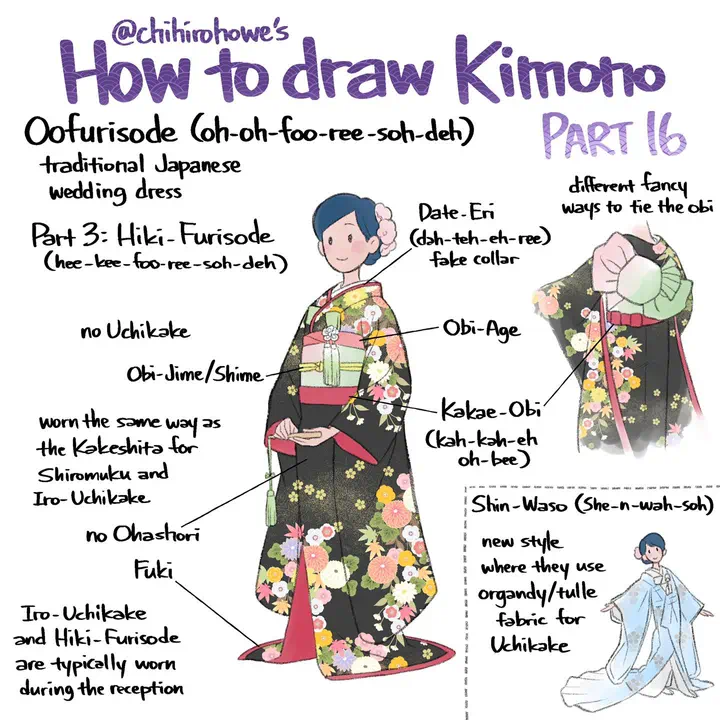
Kimonos come in many different styles for different occasions. Yukata are worn during summer to summer festivals or to onsens. Furisode are formal kimonos worn by unmarried women. Uchikake and shiromuku are worn by brides during wedding ceremonies.
Juban are usually worn under the kimono as the inner layer, and used by some as sleepwear.
Of note, Kimono from the Sengoku Jidai onward are generally single-piece or layered robes tied with an obi. The Nibushiki Kimono, developed around the 1970s, is a more modern development with incorporates an obi with a two-piece shirt and dress and not considered traditional. If you are tagging a two-piece set of attire with a sash where the bottom-piece is not a hakama consider using hanbok or hanfu instead.
Examples




Related tags
Components
- Juban (underlayer)
- Han'eri (constrasting collar)
- Obi (waist sash)
- Obijime (cord tied around obi)
- Obidome (obijime accessory)
- Obiage (material under obi)
- Tasuki (sleeve ties)
Types
- Furisode (an unmarried women's kimono with floor-length sleeves)
- Hiki furisode (a formal furisode for bridesmaids)
- Layered kimono (an intricate Heian-era kimono)
- Karaginu mo (a kimono for the Empress and royal ladies)
- Kimono skirt (a short kimono with a skirt)
- Funeral kimono (a black kimono worn at funerals)
- Right-over-left kimono (a kimono with its right side folded over its left side, used for the dead)
- Shiroshouzoku (a funeral kimono for the deceased)
- Short kimono (a knee-length kimono)
- Susohiki (a kimono worn by geisha and kabuki actors)
- Uchikake (a wedding kimono)
- Shiromuku (a pure-white wedding kimono)
- Yukata (a light summer kimono for casual / normal days)
- Short yukata (a knee-length yukata)
- Bath yukata (a yukata for bath or shower)
Colors
- Aqua kimono
- Black kimono
- Blue kimono
- Brown kimono
- Green kimono
- Grey kimono
- Orange kimono
- Pink kimono
- Purple kimono
- Red kimono
- White kimono
- Yellow kimono
- Multicolored kimono
Styles
- Backless kimono
- Checkered kimono
- Fur-trimmed kimono
- Frilled kimono
- Lace-trimmed kimono
- Pinstripe kimono
- Plaid kimono
- Polka dot kimono
- Print kimono
- Ribbon-trimmed kimono
- See-through kimono
- Sleeveless kimono
- Striped kimono
States
另请参见
- Haori
- Wa lolita
- Ikou (kimono clothes hanger)
- Tag group:Attire
External links
The following tags are aliased to this tag: kosode (learn more).
This tag implicates japanese_clothes (learn more).
The following tags implicate this tag: aqua_kimono, black_kimono, blue_kimono, brown_kimono, checkered_kimono, frilled_kimono, funeral_kimono, fur-trimmed_kimono, furisode, gradient_kimono, green_kimono, grey_kimono, kimono_lift, kimono_pull, kimono_skirt, lace-trimmed_kimono, layered_kimono, multicolored_kimono, naked_kimono, open_kimono, orange_kimono, pink_kimono, pinstripe_kimono, plaid_kimono, polka_dot_kimono, print_kimono, purple_kimono, red_kimono, ribbon-trimmed_kimono, see-through_kimono, shiroshouzoku, short_kimono, sleeveless_kimono, striped_kimono, torn_kimono, uchikake, white_kimono, yellow_kimono, and yukata (learn more).
和服通常与其他传统配饰一起穿着,例如 zouri(传统木凉鞋)、tabi(分趾袜)和 kanzashi(传统发饰)。穿着和服时通常会携带金签(小布抽绳袋)。
和服有许多不同的款式,适合不同的场合。浴衣是在夏季、夏季节日或泡温泉时穿着的。长袖是未婚女性穿着的正式和服。打挂和白无垢是新娘在婚礼上穿着的衣服。
值得注意的是,从战国时代开始的和服通常是单件或分层的长袍,并系有腰带。 Nibushiki 和服是在 1970 年代左右开发的,是一种更现代的发展,将腰带与两件式衬衫和连衣裙结合在一起,并不被认为是传统的。如果您用腰带标记两件套服装,而下半身不是裤裙,请考虑使用韩服或汉服。
以下标签暗示此标签:aqua_kimono、black_kimono、blue_kimono、brown_kimono、checkered_kimono、frilled_kimono、furier_kimono、fur-trimmed_kimono、furisode、gradient_kimono、green_kimono、grey_kimono、kimono_lift、kimono_pull、kimono_skirt、蕾丝装饰_和服、分层_和服、多彩_和服、裸露_和服、开放_和服、橙色_和服、粉色_和服、细条纹_和服、格子_和服、波尔卡_点_和服、印花_和服、紫色_和服、红色_和服、缎带装饰_和服、透视_和服、 shiroshouzoku、短和服、无袖和服、条纹和服、撕裂和服、打挂、白色和服、黄色和服和浴衣(了解更多)。